Redis Agent Playbooks concepts
Understand playbooks, entries, versions, publication, discovery, proposals, and evidence.
Playbooks
Redis Agent Playbooks store reusable answers and procedures as entries inside playbooks. A playbook is a registry with its own access grants and retrieval settings. Publish an entry version for retrieval, then revise new content while agents use that publication.
Embeddings and semantic search match agent tasks with relevant entries. Discovery settings control similarity thresholds and result limits. Your application supplies the task text and retrieval options.
A proposal inbox holds suggested FAQs, skills, and evidence for review.
Access grants apply across a playbook. For example, you can give a support agent read access to a support playbook and give a content reviewer permission to write or publish. Use separate playbooks when workloads must not share visibility. Attribute filters help select content within a playbook, but do not replace access grants.
Playbook API keys can grant these actions:
| Action | What it allows |
|---|---|
read |
Retrieve published knowledge, list and inspect entry summaries, and read proposals. |
write |
Create entries, append versions, inspect drafts, delete entries, and review proposals. Includes read. |
publish |
Publish or withdraw entries and inspect versions. Includes read. |
propose |
Create proposals and attach evidence. Includes read. |
write does not include publish or propose. You can assign authoring and publication to different people or applications.
Entries
An entry is a reusable answer or procedure. Redis Agent Playbooks support two types:
- A FAQ pairs a question with an answer. Retrieval returns the full answer directly.
- A skill (Agent Skill) packages instructions and optional supporting files for a procedure. Retrieval returns a preview so an agent can decide whether to load the instructions and resources.
An entry keeps the same identifier across versions. You can also assign an immutable, human-readable entry key when you create it. Use the entry identifier to maintain existing content; creating another entry produces a separate history.
Both types can include optional intents, attributes, and metadata:
- Intents are optional task paraphrases returned on discovery to help an agent or application interpret the entry.
- Attributes support exact-match retrieval filters, such as locale or audience.
- Metadata holds additional agent or application context; retrieval filters do not search it.
For fields and types, see the entry model.
Versions
A version is a complete, immutable snapshot of an entry's authored content. Updating an entry appends a new version rather than editing the existing snapshot.
The latest version and the published version can differ. Version 2 of a refund procedure can remain under review while agents retrieve version 1. Publishing version 2 switches retrieval to the update and retains version 1 for rollback.
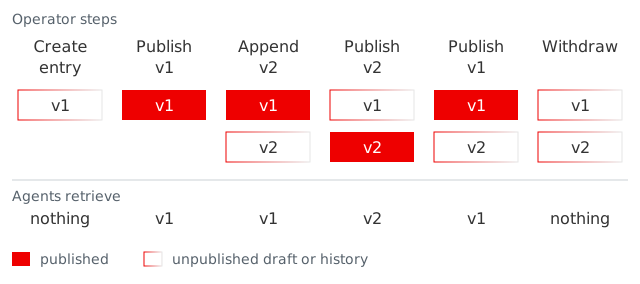
Management operations let you inspect drafts and historical versions with the required permissions. See the version model for fields and types.
Publication
Publication selects the version of an entry that search and discovery can return.
Publish a reviewed version to make it available to agents. Publish an earlier version to roll back. Withdraw the publication to stop serving the entry while retaining its history. Delete the entry to remove it and its versions permanently.
Discovery
Discovery returns relevant, published FAQ answers and skill previews for an agent task.
Similarity scores help rank relevant content. Filter attributes narrow the audience or topic. Pins let an application select known published skills or FAQs regardless of similarity.
For skills, the agent selects a preview, loads its instructions, and fetches supporting files as needed. Your application controls how it uses that content.
Proposals
A proposal is a suggested playbook entry awaiting expert review. See the proposal model for fields and types.
A human or agent can suggest a FAQ or skill, edit the candidate, or attach evidence.
Accepting a reviewed proposal promotes its FAQ or skill candidate into a new unpublished entry. Publication remains a separate action. Proposals do not revise existing entries.
Evidence
Evidence gives reviewers source context for a proposal. It can come from background extraction or an authorized client acting for a human or agent. See the evidence model for fields and types.
More evidence means more submitted observations, not greater factual accuracy. Check the candidate against its sources before accepting and publishing it.
See Review proposals for the procedure.
Extraction
Extraction turns agent interactions into suggested reusable knowledge. Redis Agent Memory stores the conversations; Redis Agent Playbooks use those conversations to propose answers for review. For example, a support conversation that resolves a refund question can suggest a FAQ for future agents.
An administrator connects a Redis Agent Memory store to a playbook through an extraction binding and enables a background worker. The worker reads eligible idle sessions, derives questions and answers from their events or summaries, and compares them with published FAQs and open proposals. It can create a proposal or attach another observation as evidence to an existing open proposal. An observation already covered by a published FAQ can require no new proposal.
You can also build your own producer that calls the proposal and evidence APIs directly. Your application chooses the source material, generates candidates, and decides whether to create a proposal or add evidence. Both approaches use the same review process: acceptance creates an unpublished entry, and publication makes the reviewed version available to agents.
Background extraction supports FAQs. Applications can submit FAQ or skill proposals directly. See Automate proposal generation for both approaches and extraction setup for administration.