Redis Cloud changelog (May 2026)
New features, enhancements, and other changes added to Redis Cloud during May 2026.
| Redis Cloud |
|---|
New features
Redis Iris
Redis Iris is a suite of fully-managed services that give AI agents the context engine they need to reliably act on business data. Both Redis Agent Memory and Redis Context Retriever are now available on Redis Cloud as a public preview.
Bring your own Cloud resource tags
Accounts with Redis Cloud Bring your own Cloud (BYOC) enabled can now add Cloud Provider resource tags to their BYOC deployments. See Resource tags for more information.
Redis 8.6 on Redis Cloud Essentials
Redis 8.6 is now available for Redis Cloud Essentials databases in select regions.
Dynamic endpoints
Redis Cloud is gradually rolling out dynamic endpoints. During the rollout, some databases will display both a dynamic endpoint and a legacy static endpoint, while some newly created databases will display only a dynamic endpoint. Previously assigned static endpoints will continue to work for now but may be deprecated in the future.
Static endpoints on Redis Cloud start with redis-<port>.c<number> (or redis-<port>.internal.c<number> for the private endpoint). For example, a static endpoint might look like this:
redis-12345.c12345.us-east-1-mz.ec2.cloud.rlrcp.com
Dynamic endpoints on Redis Cloud always contain three words and a random number, and end in db.redis.io. For example, a dynamic endpoint might look like this:
horse-battery-staple-12345.db.redis.io
You can see the Dynamic endpoints for databases with both static and dynamic endpoints by expanding the Dynamic endpoints section in the General section of the Configuration tab.
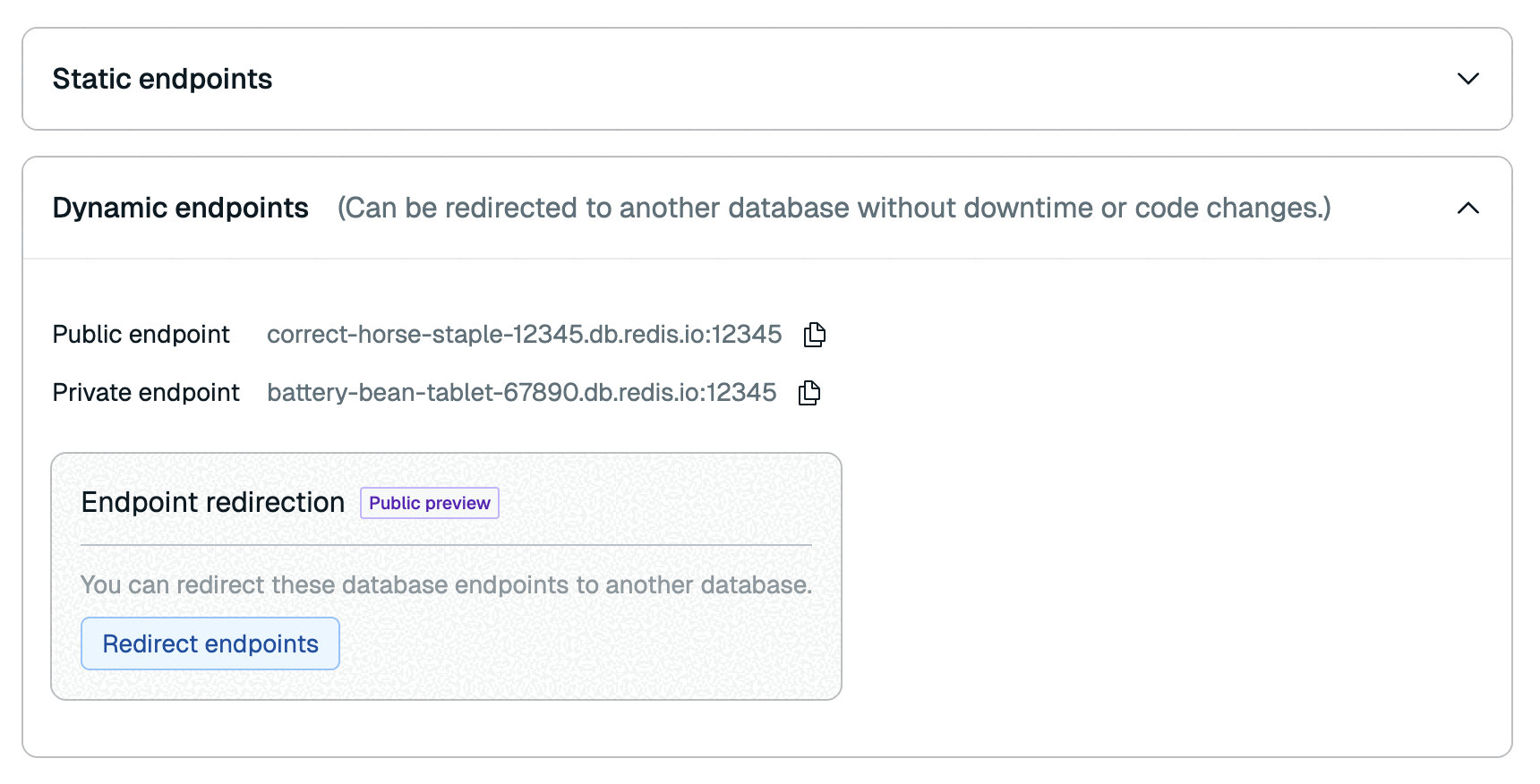
We recommend slowly migrating connections to the dynamic endpoints. Moving connections from the static endpoints to the dynamic endpoints does not cause any downtime. See Applications that use legacy static endpoints for more information.
Redirect dynamic endpoints
Dynamic endpoint redirection is currently in public preview. Features and behavior are subject to change.
You can redirect your dynamic endpoints to any Redis Cloud Pro database in the same account. Redirecting your dynamic endpoints lets you switch connections to your new database seamlessly through Redis Cloud without any code changes. See Redirect database endpoints for more information.
Enhancements
Metrics resolution updates
This change only affects Redis on RAM databases. Flex and Auto Tiering databases continue to use the previous metrics time ranges.
The metrics tab of a Redis Cloud database now displays database metrics at different levels of granularity depending on the selected time range. Short time ranges now show finer granularity for detailed investigation, and longer time ranges use aggregated intervals for clearer trend analysis. See Metric intervals for a list of available intervals and their corresponding resolutions.
To simplify the monitoring experience and ensure each time range provides meaningful insight, the 1 minute and 1 year ranges have been removed. The 1 year range has been replaced with a 3 month range.