

Agents don’t have an intelligence problem. They have a context problem. They fail because their context layer is scattered, stale, slow, or hard to use.
That’s why we’re introducing Redis Iris, our new context and memory solution that turns fragmented enterprise data into live, agent-ready context. Redis Iris is a context engine, an important layer in an AI stack that sits between an agent and the data it needs to act, feeding the right context, in the right form, at the right time.
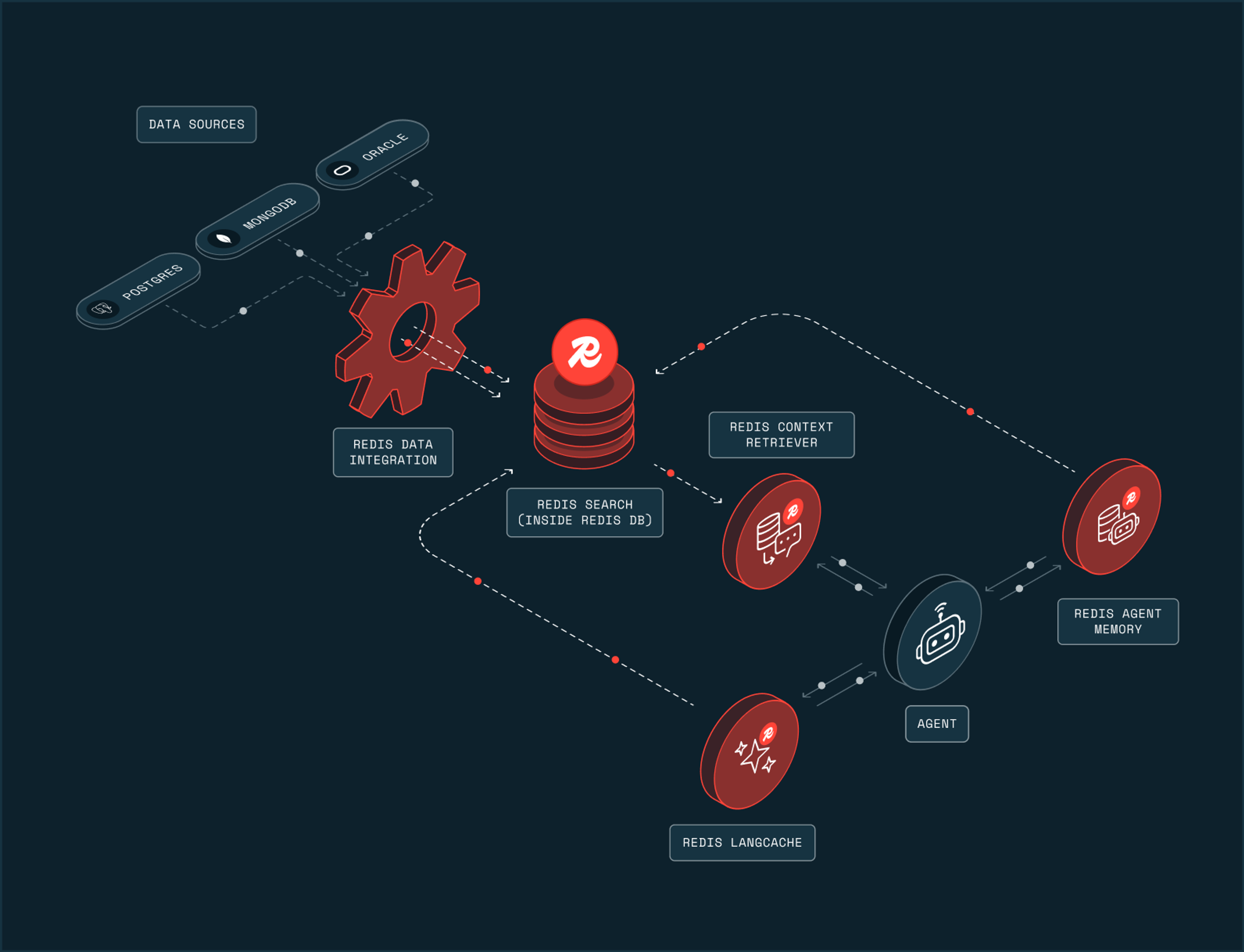
Iris is composed of five tools, Redis Context Retriever, Redis Agent Memory, Redis Data Integration, Redis LangCache, and Redis Search. Two of these are brand new to Redis. Context Retriever makes external data sources navigable by agents. Agent Memory preserves short- and long-term context across tasks and agents.
It’s all built on top of Redis, storing and serving the underlying vector, structured, unstructured, and real-time data that scales alongside your agent fleets.
Why a context engine?
For customer support bot, the answer to “Why is my order late?” may be spread across a customer database, an order system, a shipping provider, a ticketing tool, and a policy document. Without a context engine, the bot either gives a generic answer or relies on brittle, one-off integrations that expose a lot of low-level complexity.
A context engine creates a governed, agent-readable view of the data it needs to answer that question. In this example, it would define business entities like customers, orders, shipments, tickets, and policies, as well as the relationships and access rules between them. The bot can then retrieve the right customer, order, shipment status, policy, and prior interaction in one flow. The result is an agent that answers using the customer’s actual situation, not just static documentation.
The hardest problems in production AI are no longer solved by model choice. They show up at runtime: stale state, slow retrieval, fragmented memory, disconnected tools, and sessions that fail to compound. A context engine gives agents fast, reliable access to the operational data and memory they need while they’re working.
For agents to function at scale, a context engine has to meet four requirements:
- Context that is navigable by agents. Agents need a way to traverse relationships, understand entities, discover relevant context, and access it through consistent interfaces. They should be able to move from an account to its opportunities, from a support interaction to the underlying customer state, and from a document to the systems and workflows it references. That’s the difference between raw retrieval and agent-native context.
- Context that is retrievable quickly. Production systems can’t tolerate slow retrieval. Latency hits UX, workflow completion time, throughput, and cost. Even the best context model is useless if agents can’t access it at production speed. Fast retrieval is what makes the rest of the system work.
- Context that is always up to date. A business’s context is always changing. CRM records update, warehouse tables refresh, new files land in object storage, transactions arrive, and app state evolves in real time. A context engine has to reflect those changes continuously—not through brittle batch-only workflows. Agents need to trust that the context they’re using reflects the current state of the business.
- Context that gets better over time. Context should not just be current. It should compound. As the system is used, it should become more personalized, more relevant, and more informed by prior interactions and durable state. That means the context layer must support memory, learning, and accumulation over time. That’s how a retrieval layer becomes a context layer that keeps improving.
Redis Iris, an end-to-end context engine
Redis is already in the agent runtime, used by 43% of enterprise AI agent stacks to serve the hot operational state agents need. We combine sub-millisecond performance, memory, and retrieval in one package so agents can meet real production demands like voice turn-taking, fraud scoring, and customer experiences that carry across sessions.
Because Redis is multi-cloud, BYOC, and works across any agent platforms, teams get the context layer they need without turning their AI strategy into a hyperscaler lock-in decision.
Redis Iris combines five tools, rolled up into a single runtime that makes context navigable, current, fast, and better over time.
- Context Retriever lets devs define a semantic model for business data—entities, fields, relationships, and access rules—and then auto-generates MCP tools agents can use instead of querying databases directly. At runtime, agents authenticate with scoped keys, discover only the tools they’re allowed to use, and execute indexed lookups through Redis and Redis Search, with row-level filters enforced server-side. It gives agents a controlled retrieval layer over structured business data, instead of relying on text-to-SQL or custom integrations for every workflow. Now available in preview.
- Agent Memory manages short-term conversational state and longer-term durable memory for agent apps. It stores, updates, and retrieves context like recent interaction history, user preferences, and other persisted attributes in Redis so agents can maintain state across turns and sessions without reloading or re-deriving that information every time. Now available in preview.
- Redis Data Integration ingests and synchronizes data from source systems like relational databases, data warehouses, and document stores into Redis. That data is stored in Redis in formats optimized for agent access, creating a continuously updated operational data plane that separates systems of record from agent-facing retrieval and serves context in real time.
- LangCache provides low-latency semantic caching to shorten response time, and save up to 90 percent on token costs.
- Redis Search the fast layer underneath the context engine that retrieves a company’s vector, structured, unstructured, and real-time data
Try Redis Iris today
If you’re already building real-time agents, you don’t need another vendor in your stack. You need a better runtime layer for the one you already have.
Redis Iris extends the Redis infrastructure teams already know and trust, bringing navigable retrieval, fresh operational state, compounding memory, and fast semantic search into one engine instead of spreading them across a tool zoo of vector databases, memory services, streaming pipelines, caches, and custom glue.
That means agents can work with the context they need while they’re actually running. They can navigate business entities through a schema instead of gambling on text-to-SQL. They can retrieve fresh state without forcing teams to own another ETL pipeline. They can carry memory across sessions and channels. And they can stay inside the latency budgets that matter for voice, fraud, personalization, and customer experience.
The payoff: simpler agent architecture, fewer seams to debug, and agents that get faster, more reliable, and more useful in production.
The easiest way to see the difference is to try it. Use your existing Redis Cloud account to start adding context capabilities to your agent stack, or create a new Redis Cloud account for free.
Start with the Redis you already know, now built to scale with your agents.
Get started with Redis today
Speak to a Redis expert and learn more about enterprise-grade Redis today.