
Blog
Startup Spotlight: Neuron Systems keeps AI personalities consistent across NFL and cricket with Redis


Most AI systems don’t have a memory problem. They have a retrieval problem. Under real load, they can’t access what they know fast enough to matter.
Neuron Systems built a multi-agent debate platform for sports content creators. Six distinct AI personalities analyze live games simultaneously, generating real-time commentary across an entire NFL season from Week 1 through the Super Bowl. Each agent had a name, a reasoning style, a voice. Marcus was experiential. Leo was statistical. Zareena was contrarian. Sam was balanced. Big Mike was emotional. The Architect was tactical.
Keeping those six personalities distinct, accurate, and fast under live game pressure required something most AI architectures treat as an afterthought: a memory layer fast enough to serve agent reads mid-output. The answer wasn’t better prompts. It was Redis.
"Building a real-time multi-agent system without fast state access is like running six people off the same notes app. Someone always gets the wrong version."
The memory challenge in real-time multi-agent systems
When Neuron Systems first deployed the agent platform for NFL Sundays, the failure modes were unexpected. The agents did not crash. They did not hallucinate catastrophically. They didn’t break. They drifted.
Under heavy load, multiple games running simultaneously, hundreds of concurrent creators, the kind of volume that only shows up in the 4th quarter of a playoff game, agents would slowly lose what made them distinct. The Architect would start sounding like a generic sports commentator. Leo would stop citing specific statistics and reach for vague patterns instead. The personality that creators had chosen would quietly evaporate.
The root cause was state. Each agent needed three things, in real time:
- Its own behavioral primitives: the specific tone, cadence, reasoning style, and personality state that defined it
- The current match context: live score, key moments, pressure index, tactical situation
- Its own performance history: rolling quality averages, recent calibration data, what it had already said
Without fast, consistent access to all three, agents would fall back on what the model knew by default: generic and indistinct
The system needed a memory layer that could serve these reads at sub-2ms average latency, sustain 10,000 to 50,000 reads per second at Super Bowl peak, and do it reliably across 11 hours of continuous multi-game operation every NFL Sunday.
The three-layer Redis architecture
Neuron Systems built what they call the Three-Layer Redis Memory Stack. Each layer serves a distinct purpose, operates at a different TTL, and addresses a specific failure mode in the multi-agent system.
| LAYER | REDIS ROLE | WHAT IT SOLVES |
|---|---|---|
| Layer 1 Live State Cache | cricket:match:{id}:statecricket:match:{id}:momentsenricher:{id}:state24h TTL | Real-time match context available to every agent mid-output |
| Layer 2 Episodic Memory | cricket:match:{id}:cardscricket:match:{id}:blocks24h TTL | Approved and blocked outputs stored per match for agent awareness |
| Layer 3 Agent Memory | cricket:agent:{name}:{stat}7 day TTL | Rolling quality averages and calibration data per agent personality |
Table 1: The Three-Layer Neuron Redis Memory Stack. Each layer operates at a different TTL and addresses a specific failure mode.
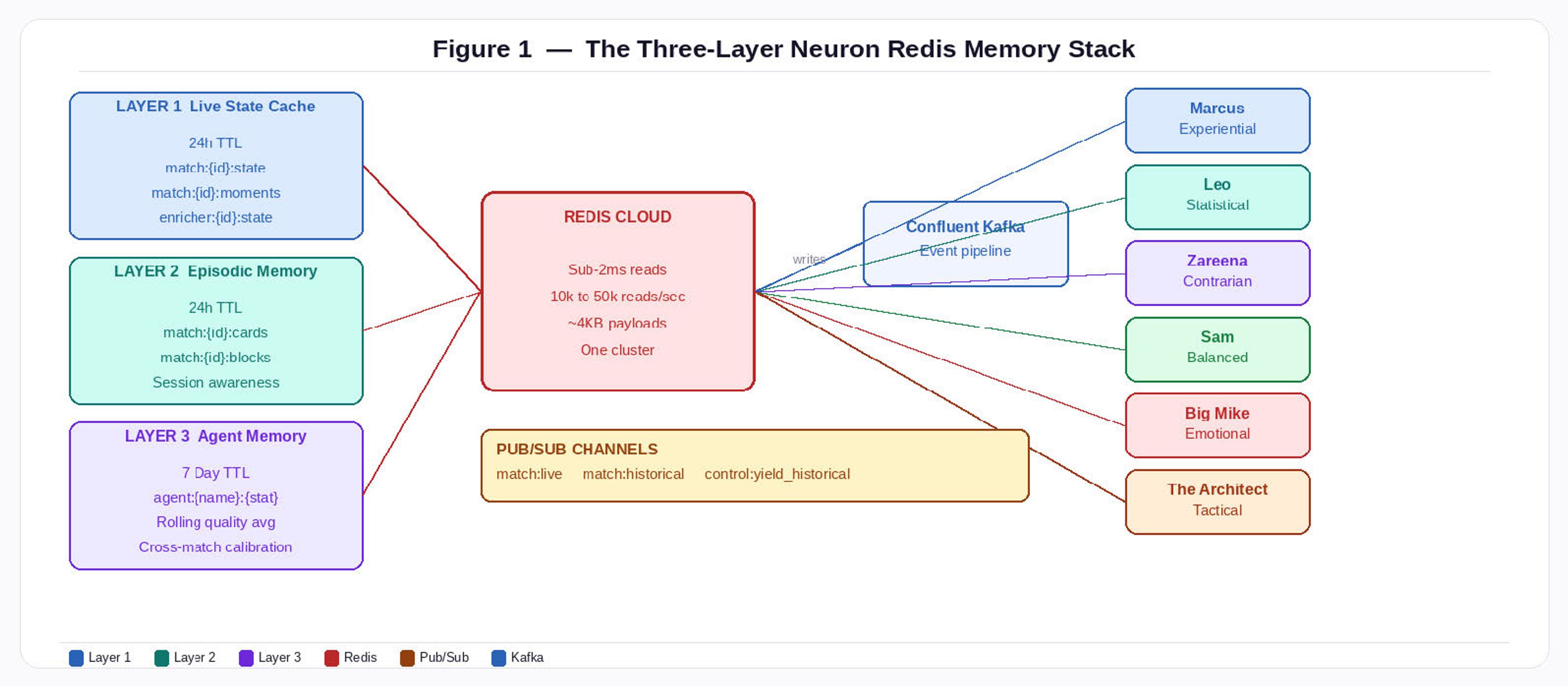
Figure 1: The Three-Layer Neuron Redis Memory Stack Architecture. Layer 1 provides live state, Layer 2 stores episodic session memory, and Layer 3 holds long-term agent calibration. All six agent personalities read from Redis at sub-2ms latency. Pub/sub channels coordinate live versus historical modes.
Layer 1: Live state cache
The first layer is the fastest and most frequently accessed. Every agent read during live commentary generation hits this layer first. It stores the current match state, updated on every event coming through the Confluent Kafka pipeline.
The critical design decision was TTL. A 24-hour window covers an entire match day without requiring explicit invalidation. The pub/sub channels sit alongside this layer, coordinating transitions between live and historical modes. The match:live channel fires when a live match is detected. The match:historical channel triggers historical debate generation between matches. The control:yield_historical channel pauses historical generation the moment a live match starts.
Layer 2: Episodic memory
The second layer stores what has already happened in the current session. Approved draft cards and blocked drafts are both written here after passing through the Rights Guardian and Quality Evaluator pipeline.
This is what prevents agents from repeating themselves. Before generating a new piece of commentary, each agent reads its episodic memory to understand what has already been said, what angles have been covered, and what was blocked by policy. A 30 percent hallucination cascade rate dropped significantly once agents had access to a shared episodic record.
Layer 3: Agent memory
The third layer operates at a 7-day TTL, which means it persists across an entire NFL week from one game to the next. It stores rolling quality averages per agent across multiple performance dimensions: insight, clarity, groundedness, uniqueness, and timing.
"Without Layer 3, the calibration system would reset every match. With it, Leo's statistical precision in the 4th quarter carries forward from last week."
NFL season performance: What the numbers said
The Redis layer ran continuously across the entire NFL season from the regular season through Wild Card weekend, divisional playoffs, conference championships, and the Super Bowl. Performance stayed consistent across the entire season.
| METRIC | VALUE | CONTEXT |
|---|---|---|
| Average read latency | 0.8ms to 2ms | Agents read mid-output without perceptible delay |
| Peak read volume | 10,000 to 50,000 per second | Super Bowl peak sustained across all agents |
| Payload size | Approximately 4KB per read | Behavioral primitives fit inside a single Redis value |
| Identity drift rate | 45% without Layer 3, under 5% with Layer 3 | Personality persistence across 11 hour game days |
| Hallucination cascade | 30% before episodic memory, significantly reduced after | Agents aware of what has already been said |
| Concurrent operation | 11 or more hours sustained | Full NFL Sunday without restart or degradation |
Table 2: NFL Season Redis Performance Metrics. Read latency, throughput, and identity stability across the full season including Super Bowl peak load.
The Super Bowl was the real test. Peak concurrent creators, maximum media volume, the highest-stakes game of the season. The Redis layer did not require intervention. Latency stayed in the 0.8ms to 2ms window. The agents stayed in character.
"The Super Bowl was the proof point. Six agents, hundreds of concurrent creators, peak load, and not a single identity drift incident that required manual intervention. Redis held."
The Spanish language layer: Behavioral primitives beyond English
Midway through the NFL season, Neuron Systems added Spanish language commentary, the first non-English implementation of the platform. This wasn’t just a language problem. It was a memory problem.
Each agent's personality does not exist only in its English prompt. It exists in the specific primitives stored in Redis: the cadence of how it builds to a conclusion, the vocabulary weight it places on statistical versus observational language, the emotional register it defaults to under pressure.
| AGENT | PERSONALITY | KEY PRIMITIVE | SPANISH DELTA |
|---|---|---|---|
| Marcus | Experiential | Observational cadence | Distinct rhythm in Spanish sports commentary required full primitive rebuild |
| Leo | Statistical | Confidence modulation | Numbers mapped well across languages but modulation primitives needed recalibration |
| Zareena | Contrarian | Challenge framing | Rhetorical challenge patterns differ significantly between English and Spanish |
| Sam | Balanced | Perspective weighting | Neutral framing conventions required Spanish-specific weight adjustments |
| Big Mike | Emotional | Emotional register | Spanish emotional vocabulary carries different connotations, primitives rebuilt from scratch |
| The Architect | Tactical | Technical vocabulary | Tactical terminology largely portable, minor weight adjustments for regional terms |
Table 3: Per-agent Spanish language primitive changes. Each agent required a distinct level of primitive rebuilding rather than direct translation.
The Spanish implementation ran through the remainder of the NFL season including the Super Bowl without regression on the English layer. Two sets of primitives, one Redis cluster, no performance degradation.
"The primitive schema built for Spanish is now the template for every additional language. Arabic, Hindi, Portuguese. Each new language is a new set of primitives, not a new architecture."
Cricket: Validating the architecture on a new sport
After the NFL season, Neuron Systems adapted the platform for cricket, specifically the T20 World Cup format. Cricket introduced new complexity that tested whether the architecture actually generalized beyond the NFL
The match structure is different. Cricket runs as a single continuous session with clearly defined phases: powerplay, middle overs, death overs. Agent personality behavior needs to shift with match phase in a way that NFL quarter structure does not require.
The solution was a match phase classifier that writes to Layer 1 continuously, allowing agents to read the current phase and modulate their behavioral primitives accordingly. Two endpoints feed the cricket pipeline via RapidAPI. The scorecard endpoint carries match state, score, and teams. The ball-by-ball commentary endpoint carries discrete match events. Both feed into an adaptive polling cycle of 10 to 60 seconds depending on match activity.
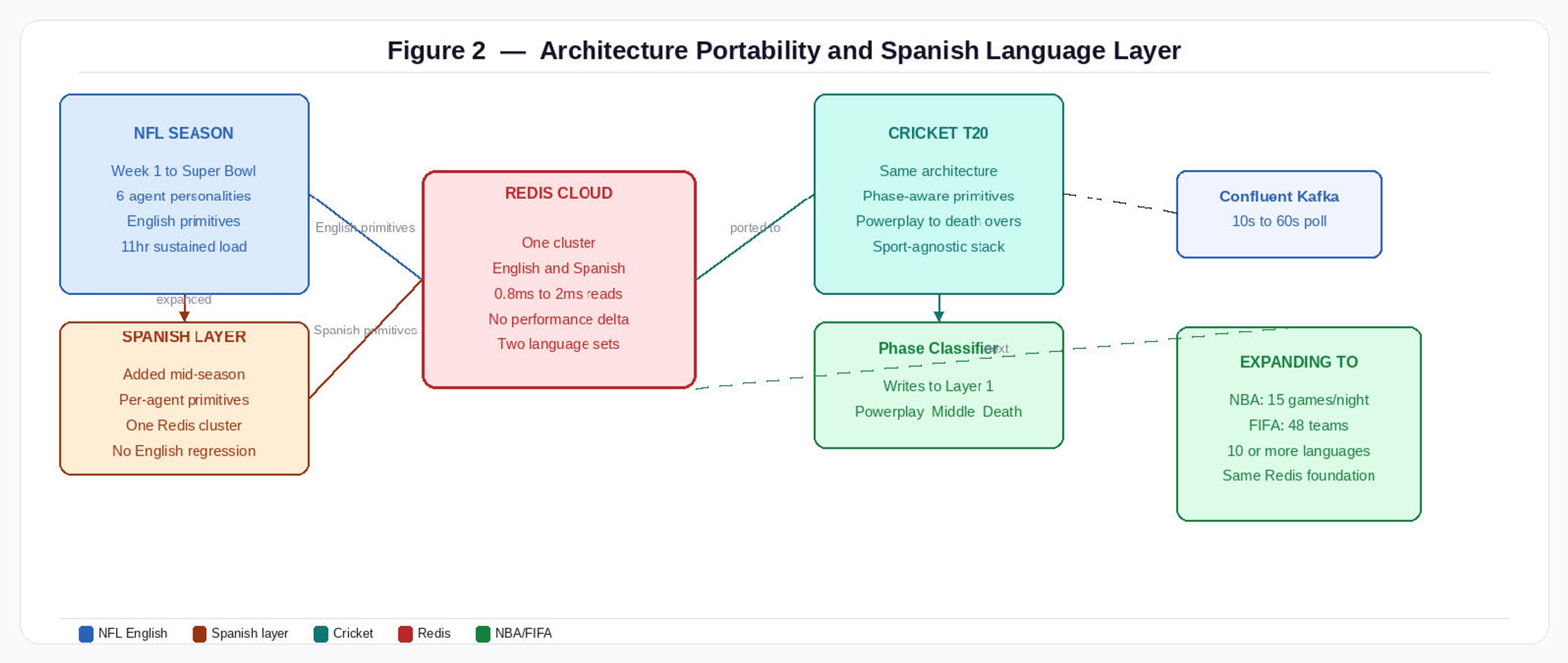
Figure 2: NFL to Cricket Portability and Spanish Language Layer. One Redis cluster serves English and Spanish primitives simultaneously across NFL, then ports to cricket with match phase classification. NBA and FIFA expansion is shown as the next target.
What Neuron Systems learned
Four lessons emerged from a full season of production operation.
| METRIC | VALUE | CONTEXT |
|---|---|---|
| Lesson | Finding | Implication |
| Speed is a personality requirement | Sub-2ms is the threshold below which agents stay in character | Redis is not an optimization. It is a functional requirement. |
| Episodic memory is underestimated | 30% hallucination cascade without it | Most implementations skip Layer 2. Neuron Systems found it essential. |
| Language is behavioral not textual | Each agent required different Spanish primitive work | Translation pipelines fail. Primitive rebuilds succeed. |
| Pub/sub is the hidden complexity | Live versus historical transition must be under 1ms | The control:yield_historical channel is as important as the data layers. |
Table 4: Key lessons from a full NFL season of production operation.
What comes next: NBA and FIFA
The Neuron Systems platform is expanding to NBA and FIFA. Both introduce new scale requirements that will test the Redis architecture further.
NBA brings concurrent multi-game volume that cricket and NFL did not require at the same scale. Up to 15 games on a single night, each requiring independent agent sessions with their own behavioral primitives and episodic memory. The 7-day TTL on Layer 3 means agent calibration will carry across a full NBA week.
FIFA World Cup 2026 is the ultimate target. 48 national teams, multilingual output across potentially 10 or more languages simultaneously, and the global viewership scale that makes peak load genuinely unpredictable. The hierarchical adapter inheritance system was designed with FIFA in mind, and the behavioral primitive schema built for Spanish is the template for the language layer.
"We did not build Redis into the architecture because it was the obvious choice. We built it in because nothing else was fast enough to keep six personalities alive in real time. Now it is the foundation everything else runs on."
How the Redis Startup Program helped
The Redis for Startups program was instrumental in accelerating Neuron Systems' deployment during a critical growth phase. The generous credit allocation allowed us to seamlessly implement Redis as the core caching and state management layer for our multi agent AI platform just in time for the high concurrency traffic of the NFL playoffs and live cricket broadcasts. Beyond the infrastructure support, direct access to the Redis Applied AI team for technical walkthroughs provided the architectural guidance we needed to rapidly scale our real-time sports commentary engine, setting the stage for our upcoming expansions into the NBA and the 2026 FIFA World Cup.
If you're focused on building and scaling high-performance applications, the Redis Startup Program is designed to support that growth from day one. Learn more and see if you qualify here: https://redis.io/startups/
Get started with Redis today
Speak to a Redis expert and learn more about enterprise-grade Redis today.