

My new car was delivered on a Monday in late October. A few days later I asked my agent (Muse) a simple question about it, and it confidently told me about the other car, the one I had sold to make room for it.
Nothing was missing from Muse’s memory. The delivery was recorded. The search had pulled a related record, treated it as equal to the right one, and handed it over. That small failure captures something general about how Muse (and many other agents) manage their memories. The models are good. The memory underneath them is usually a pile of text with minimal organization, and a pile of text has no opinion about which part of it matters.
I've been fascinated, maybe even obsessed about human memory for many years. I think this started decades ago when I read Marvin Minsky’s seminal work “The Society of Mind”. I also run Redis, and at Redis we have been building a memory service for agents called Iris. A few weeks ago I connected the agent I use every day to the memory service my company builds, and I measured both sides before and after. This post is what I found. Read it with my bias in plain view :). The measurements are the measurements, and some of them argue against my own product.
Muse saves memories well, but fails to find them later
Muse (and many other agents like it) keeps its memory the way a careful person might. There is a main memory file, written in plain language. There are daily logs. There is a page for each person in my life. On top of the files sits the full transcript of every conversation, and the agent can search those transcripts as well as the files. A short summary of the memory file rides along in every session, so the agent always starts with some idea of who I am.
I like the simplicity of this design. Everything the agent knows about me is written down where I can read it. Nothing is hidden inside vectors or complex graph databases. If the agent believes something wrong about me, I can open the file and see the sentence.
But writing a fact down and finding it again are different problems, and the design solves the first one better than the second. When the agent writes a note, it is predicting what a future session will need. It makes that prediction in the middle of a conversation, with no way to know which details will matter next week. And when a later session goes looking, it searches prose (usually using grep). Search returns passages. Passages come back without scores, pooled together from several queries, and the agent has to judge which fragment to trust.
Muse gives fluent answers that are sometimes very wrong
I gave the agent sixteen questions about its own memory about me and my life. The questions were ordinary: Where does my daughter go to school? When is a tax deadline? How do I like documents written? What did I buy, and when did it arrive?
Muse's built-in memory found ten of the sixteen in the first round. The misses had a pattern. The car question is the cleanest example. The delivery record existed, and so did the sale record for the car before it, and the search surfaced the sale. The question about how I like things written came back with formatting trivia, while the actual preference sat in the file unretrieved. One question returned a deadline with two different dates in the same passage, because I had corrected the date once and the old value had never left the record.
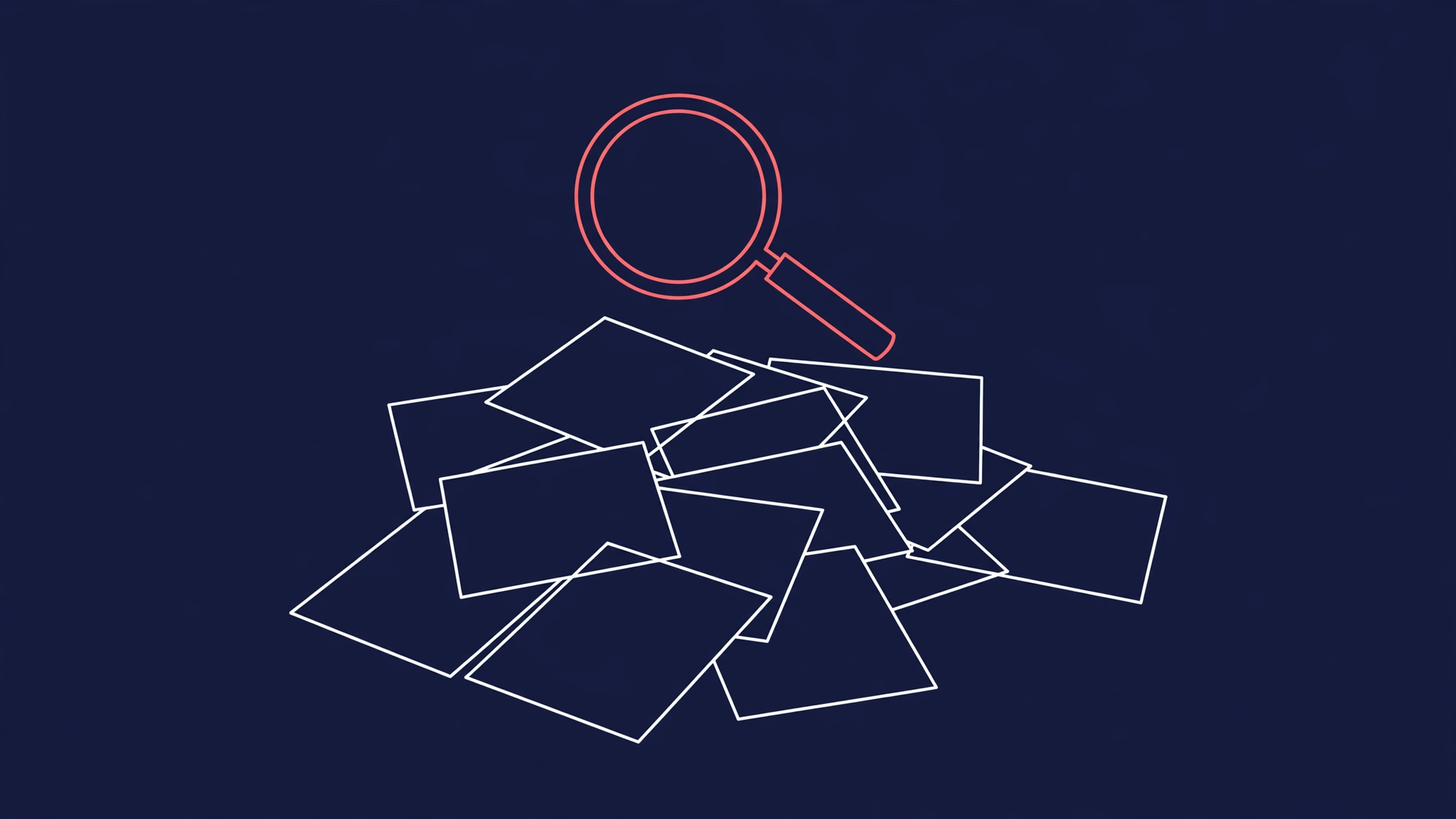
Figure one: search over prose returns a pile of passages, all presented with the same weight.
None of these failures looked like failures. The agent answered each question fluently, from something real in its memory. A memory system that loses the right fact among near neighbors does not produce errors you can catch. It produces confident answers that are slightly wrong, and it produces them every day.
Three more weaknesses showed up over a longer period of use. Facts in a file carry no identifier, so a correction is an edit to a paragraph, and copies of the old claim can survive elsewhere in the record. Nothing turns conversation into memory on its own, so capture depends on the agent pausing to write things down, and some turns it simply does not. And the memory belongs to one agent. I run a second agent for work, and it had no access to any of this. It kept its own diverging picture of my life.
Ranked records find the right answers and make corrections stick
The change I made was additive. Every turn of conversation now gets recorded into Iris as a session event, in the moment, whether or not the agent thinks the turn matters. Iris reads the accumulated sessions and extracts facts from them on its own. Each extracted fact becomes a record with an identifier, an owner, a type, and a link back to the session it came from. Search over those records is ranked, and every result carries a score.
The same sixteen questions, run again, came back sixteen for sixteen, with fifteen of the answers ranked first. The car question returned the delivery while the sale fell away. The writing preference, missed twice by the built-in search, ranked first. A separate set of four questions about the newest facts in my life split the other way, and I will come back to that, because it's relevant to my conclusion.
Corrections changed character in a way I had not fully appreciated until I watched it happen. The tax deadline that used to exist in two versions now exists in one. A correction updates the record in place, addressed by its identifier, and the superseded date is gone from the store. I verified that by searching for the old date afterward and finding nothing. Anyone who has maintained a notes folder for years (you know who you are) will recognize the difference. Appending a correction is easy. Retracting the original claim is the hard part, and it is the part a personal agent needs, because it acts on what it reads.

Figure two: a corrected record, addressed by its ID, replaces the old one instead of sitting next to it.
Testing my hypothesis with a benchmark
Next, I ran a public benchmark called LongMemEval, which tests whether an agent can answer questions about long conversation histories. To isolate the effect of extraction, I ran Iris against itself. One approach fed the conversations in as sessions and searched the extracted facts. The other approach stored the same conversations word for word and searched those.
The word for word approach won, and it won everywhere. It found seventeen of thirty answers at the first rank, against twelve for extraction. It won on questions about facts the assistant had stated, on questions that needed counting across several conversations, and on questions where the answer had never been written as a tidy fact at all. Extraction had fragmented the conversations into roughly three records per turn, and the fragments competed with each other in the ranking. Some facts only survive whole.
I take two things from this. The first is that a transcript is a ground truth, and any system that summarizes its only copy of the past will eventually summarize away the one detail a future question needs. The second is that the benchmark was testing retrieval over raw text inside a ranked search engine, which is a much stronger position than searching prose files with no scores at all. Both things can be true at once, and in my setup both of them are.
Use clean-up cycles (dreaming) with caution
Iris extracts facts continuously, and my setup also runs a dream cycle every night. It uploads anything the day's recording missed, and it looks for duplicates among the extracted records. Anthropic has written a good article on their research on dreaming. When we sleep, the hippocampus replays the day's experiences, and the ones that matter are gradually selected, compressed, and integrated into long term memory in the neocortex.
One night the dream cleanup deleted seven records that were not duplicates. My daughter has seven high school teachers, and the extracted facts about her parent teacher meetings are nearly identical sentences that differ only in the teacher's name and the time. A similarity threshold cannot tell a series from a duplicate. I restored all seven the next morning from the run log, and the records came back with their original identifiers, although they lost their links to the sessions they came from.
I do not have a clean rule for this yet. Telling a duplicate from a series requires reading the records the way a person would, checking whether the names and times actually match, and that is slower and more expensive than a threshold. For now I would rather live with duplicates than with holes. A duplicate costs a little ranking quality. A hole is worse!
Transcripts are the record; Iris is the index
The setup I run today keeps the two systems side by side, with a clear division of labor. The transcripts and the prose files are the record. They stay complete and they stay readable, and the agent searches them when a question is new, or contested, or needs the original wording. Iris sits on top as an index. Its extracted facts absorb the ordinary questions, the preferences and deadlines and current facts that an agent looks up dozens of times a day, and they answer them ranked, with scores, in about a second. A thin channel of curated records handles corrections and the facts that have to be exact.
When I ran all twenty production questions against the combination, it scored twenty out of twenty. Every fact the service had missed was sitting in the transcripts, including two decisions about the memory system itself. Every fact the files had missed came back ranked first from the service. Each side caught what the other missed, and the pattern of the misses was different enough that the combination was better than either design alone.
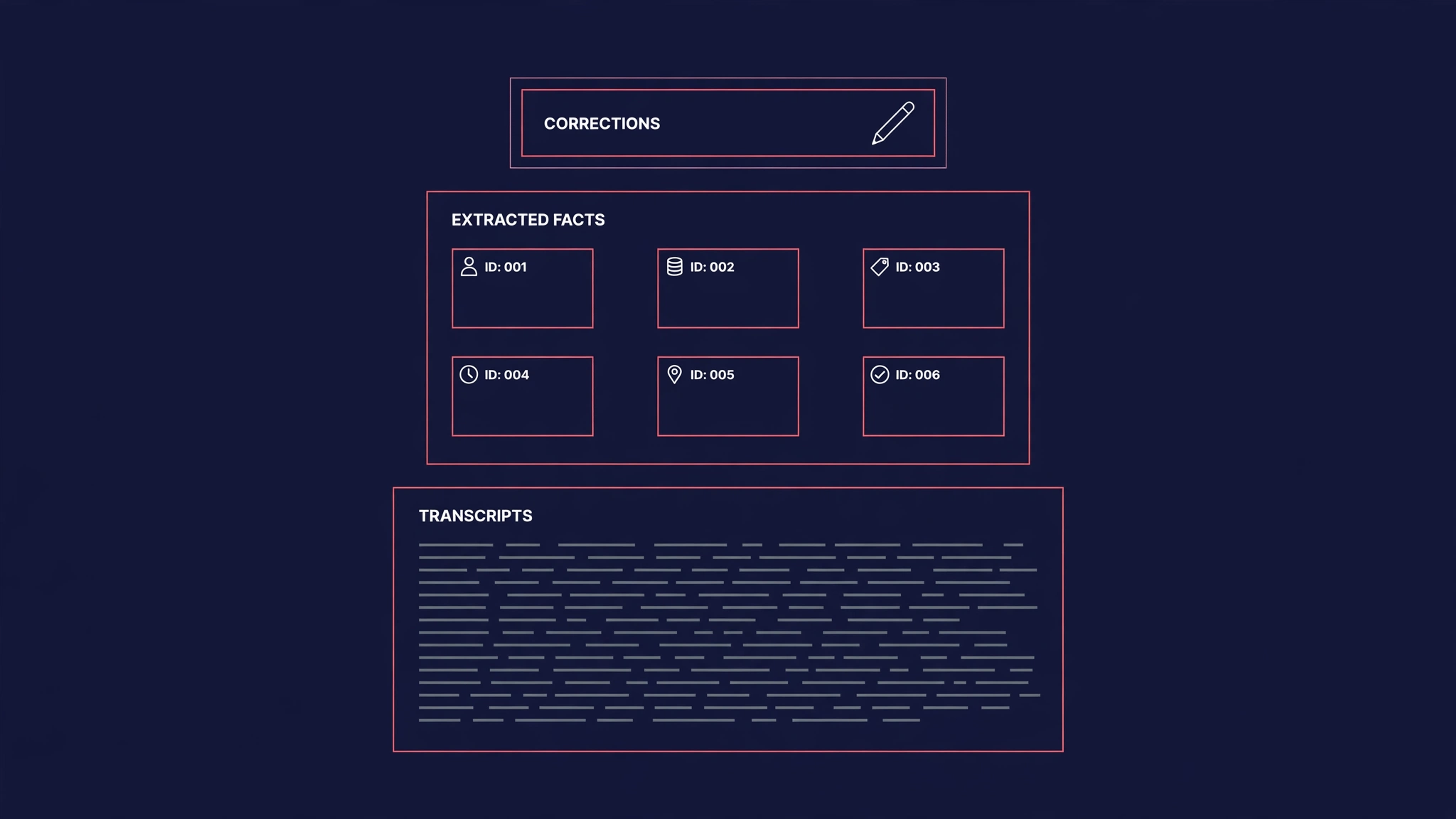
Figure three: the record at the bottom, extracted facts above it, corrections at the top.
There is one more benefit that no benchmark I ran can show. The extracted store is shared. My second agent reads and writes the same records as the first, under the same owner. What one agent learns about my preferences in the morning, the other agent knows in the afternoon, with no handoff message in between. A memory that lives inside one agent's files cannot do that, and as people start running several agents at once, I suspect this is the property that ends up mattering most.
Mostly, I am stoked that I did this research. I started to get annoyed about a wrong answer concerning a car. I have ended it with a much better set of agents, Muse and ChatGPT Dots, both reading from the same memory and both checked against the same record.
Questions I still have
I do not know how far the transcript search stretches. The published research on long context retrieval is not comforting on this point! Systems that answer nearly perfectly over short histories lose a third of their accuracy when the history grows to a hundred thousand tokens with distractors mixed in. My transcripts grow every day. The extracted index exists partly so that the transcript search is reserved for the questions it handles best, and I do not know yet whether that division holds at ten times my current volume.
I also do not know when memory should be written. Recording everything and extracting later is safe, and it costs compute and creates noise that the dream cycle then has to clean. Writing in the moment is precise, and it depends on an agent predicting the future correctly, which agents do badly, including mine. At the moment I lean toward recording everything and accepting the cleanup cost, but I hold that view loosely.
And I do not know who checks the checker. The dreaming system deleted seven real facts, the system reported success. The run log was honest, and I caught it because I read the log. Scale that to years of accumulated memory and this approach becomes a problem.
The other system I'm running is a second brain/LLM Wiki, which is constantly curated and updated during my dream cycle. My next project is to improve the dream cycle using some of the approaches outlined in the latest research from Anthropic.
If you are building an agent and trying to solve the memory problem, my advice is to build it in layers. Keep the raw files whole and verbatim, because they are the record everything else gets checked against. Put Iris on top of them and let it extract the facts, give them identifiers and rankings, and take the corrections. Then add the third layer, a wiki in the LLM wiki style, curated during the dream cycle, where the durable understanding lives. Share the store across every agent you run. And test the memory with real questions before you trust it, because it will not tell you when it is failing. It will tell you about the wrong car instead, fluently, and you will only notice if you already know the answer.



Get started with Redis today
Speak to a Redis expert and learn more about enterprise-grade Redis today.