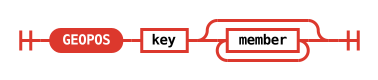
geopos(
    name: KeyT,
    *values: FieldT
) → ResponseT
GEOPOS(
    key: RedisArgument,
    member: RedisVariadicArgument
) → Any
geopos(
    key: byte[],
    members: byte[]...
) → List<GeoCoordinate>  // A list of GeoCoordinate representing longitude and latitude (x,y) of each member name passed as argument to the command.

geopos(
    key: String,
    members: String...
) → List<GeoCoordinate>  // A list of GeoCoordinate representing longitude and latitude (x,y) of each member name passed as argument to the command.

geopos(
    key: String,
    members: String...
) → List<GeoCoordinate>  // A list of GeoCoordinate representing longitude and latitude (x,y) of each member name passed as argument to the command.
geopos(
    key: K,  // the key of the geo set.
    members: V...  // the members.
) → List<GeoCoordinates>  // a list of GeoCoordinatess representing the x,y position of each element specified in the arguments. For missing elements null is returned.
geopos(
    key: K,  // the key of the geo set.
    members: V...  // the members.
) → RedisFuture<List<GeoCoordinates>>  // a list of GeoCoordinatess representing the x,y position of each element specified in the arguments. For missing elements null is returned.
geopos(
    key: K,  // the key of the geo set.
    members: V...  // the members.
) → Flux<Value<GeoCoordinates>>  // a list of GeoCoordinatess representing the x,y position of each element specified in the arguments. For missing elements null is returned.
GeoPos(
    ctx: context.Context,
    key: string,
    members: ...string
) → *GeoPosCmd
GeoPosition(
    key: RedisKey,  // The key of the set.
    members: RedisValue[],
    flags: CommandFlags  // The flags to use for this operation.
) → GeoPosition?[]  // The command returns an array where each element is a two elements array representing longitude and latitude (x,y) of each member name passed as argument to the command. Non-existing elements are reported as NULL elements of the array.

GeoPosition(
    key: RedisKey,  // The key of the set.
    member: RedisValue,  // The member to get.
    flags: CommandFlags  // The flags to use for this operation.
) → GeoPosition?  // The command returns an array where each element is a two elements array representing longitude and latitude (x,y) of each member name passed as argument to the command. Non-existing elements are reported as NULL elements of the array.

GeoPositionAsync(
    key: RedisKey,
    member: RedisValue,
    flags: CommandFlags
) → Task<GeoPosition?>

GeoPosition(
    key: RedisKey,  // The key of the set.
    members: RedisValue[],
    flags: CommandFlags  // The flags to use for this operation.
) → GeoPosition?[]  // The command returns an array where each element is a two elements array representing longitude and latitude (x,y) of each member name passed as argument to the command. Non-existing elements are reported as NULL elements of the array.

GeoPosition(
    key: RedisKey,  // The key of the set.
    member: RedisValue,  // The member to get.
    flags: CommandFlags  // The flags to use for this operation.
) → GeoPosition?  // The command returns an array where each element is a two elements array representing longitude and latitude (x,y) of each member name passed as argument to the command. Non-existing elements are reported as NULL elements of the array.
GeoPositionAsync(
    key: RedisKey,
    member: RedisValue,
    flags: CommandFlags
) → Task<GeoPosition?>

GeoPosition(
    key: RedisKey,  // The key of the set.
    members: RedisValue[],
    flags: CommandFlags  // The flags to use for this operation.
) → GeoPosition?[]  // The command returns an array where each element is a two elements array representing longitude and latitude (x,y) of each member name passed as argument to the command. Non-existing elements are reported as NULL elements of the array.

GeoPosition(
    key: RedisKey,  // The key of the set.
    member: RedisValue,  // The member to get.
    flags: CommandFlags  // The flags to use for this operation.
) → GeoPosition?  // The command returns an array where each element is a two elements array representing longitude and latitude (x,y) of each member name passed as argument to the command. Non-existing elements are reported as NULL elements of the array.

GeoPosition(
    key: RedisKey,  // The key of the set.
    members: RedisValue[],
    flags: CommandFlags  // The flags to use for this operation.
) → GeoPosition?[]  // The command returns an array where each element is a two elements array representing longitude and latitude (x,y) of each member name passed as argument to the command. Non-existing elements are reported as NULL elements of the array.

GeoPosition(
    key: RedisKey,  // The key of the set.
    member: RedisValue,  // The member to get.
    flags: CommandFlags  // The flags to use for this operation.
) → GeoPosition?  // The command returns an array where each element is a two elements array representing longitude and latitude (x,y) of each member name passed as argument to the command. Non-existing elements are reported as NULL elements of the array.
geopos(
    $key: string,
    $members: array
) → array
geo_pos(
    key: K,
    members: M
) → (Vec<Option<geo::Coord<f64>>>)
geo_pos(
    key: K,
    members: M
) → (Vec<Option<geo::Coord<f64>>>)